
Canadian News Deep-Dives — October 31, 2026: Canada's EU 'Associate Member' Push, a Record El Niño Winter, Backstreet Boys Seat Refunds
Three deep-dives: what Canada actually got from the Canada-EU summit and what 'associate member' would mean, what a record 'super' El Niño means for your winter, and why Backstreet Boys fans in Toronto face a Nov. 22 refund-or-relocate choice.
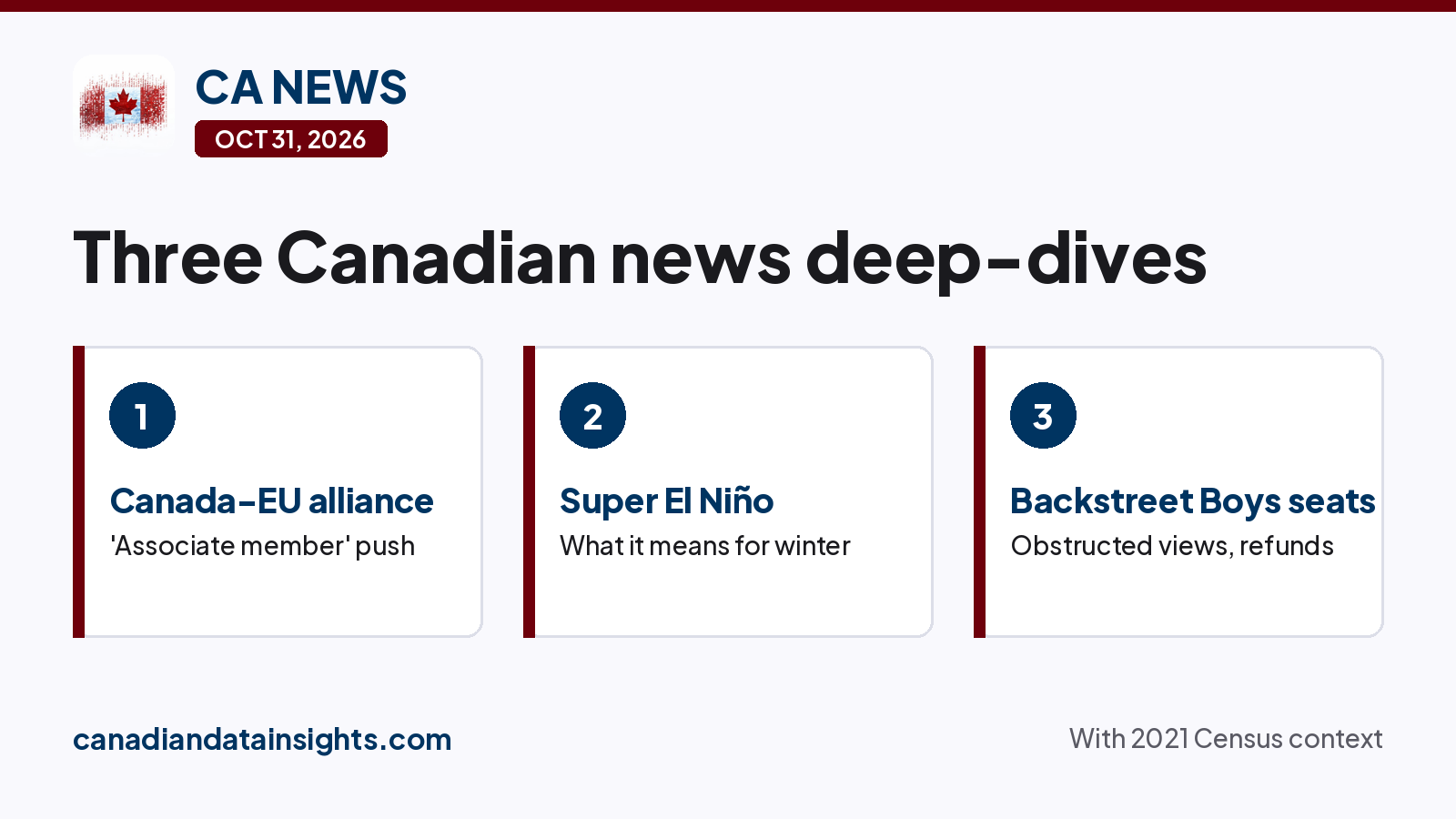
TL;DR: Today's most-searched Canadian news stories on Google Trends Canada, explained in depth. Canada and the EU launched an Alliance for the Future in Montreal, and Prime Minister Mark Carney says Canada wants to become the EU's first associate member, a status that doesn't exist yet. A record "super" El Niño points to a milder-than-normal winter for most of Canada, but a drier one in the West. And Backstreet Boys fans who bought obstructed-view presale seats for the 2027 Toronto shows say their replacement seats are worse, with a Nov. 22 refund-or-relocate deadline.
1. Canada wants to be the EU's first 'associate member.' Here's what was actually agreed
Canada hosted the 21st Canada-EU Summit in Montreal on Oct. 29-30, with European Council President António Costa and European Commission President Ursula von der Leyen. The leaders launched the Alliance for the Future and announced more than twenty new measures (Prime Minister of Canada). "We are working toward the deepest possible partnership, short of accession because of our geography, with Canada becoming the European Union's first associate member," Carney said in his closing remarks (CBC News).
What's signed or concluded: a Canada-EU Digital Trade Agreement, Canada's first agreement dedicated entirely to digital trade; a Canada-EU Competition Agreement to crack down on anti-competitive practices on both sides of the Atlantic; and Canada joining the European High Performance Computing Joint Undertaking, which gives Canadian researchers and businesses access to the JUPITER supercomputer. Ottawa also announced up to $2.5 billion in financing for Alberta-based De Havilland to increase waterbomber production, and a more than $44 million contract for Montreal-based Galvion to supply military helmets to Latvia (Prime Minister of Canada).
What's still to negotiate: connecting Canadian and EU instant payment systems, a working group on opening banking and insurance markets, expanding Canada's role in the Erasmus+ student exchange program, and joining the next Horizon Europe research program (Prime Minister of Canada).
The catch on 'associate member': the status doesn't currently exist in the EU. Sources told CBC News the term was removed from the draft joint statement, with one saying Germany called it a red line; the final text calls for "an ever-closer association of Canada to the EU, short of full membership itself." A Canadian official said there is no formal process: "It's a concept." Asked about cost, Carney said "we don't view this as paying for something, we view this as coming together." He wants to conclude negotiations in June, with Canada's cabinet and the European Commission meeting in March. EU members would have to vote, and Carney has said a new partnership will go to a vote in Parliament. Opposition Leader Pierre Poilievre called the summit "big talk" with a lack of concrete results (CBC News).
The trade stakes: the EU is Canada's second-largest trading partner for goods and services, about $178 billion in 2025, and Canadian businesses exported nearly $15 billion in digitally deliverable services to the EU in 2024 (Prime Minister of Canada).
By the numbers (2021 Census): in Montreal, the summit's host city, 58.5% of residents (1,018,100 of 1,741,260) could speak both English and French, compared with 18.0% across Canada (6,581,680 of 36,620,955).
Why it matters to you: the concrete wins are mostly for businesses and researchers for now. Watch March and June for what "associate member" would actually mean, and what it would cost.
Sources: Prime Minister of Canada · Joint statement · CBC News
2. A record 'super' El Niño: what it means for Canada's winter
This year's El Niño, a warming of the central Pacific Ocean, hasn't even peaked yet; that's expected some time in December. It has already broken records, with daily ocean temperatures reaching nearly 3.5 C above the 1991-2020 average, beating the previous high of 3.08 C in 2015 (CBC News).
Not yet: Bill Merryfield, a research scientist with Environment and Climate Change Canada, says El Niño's larger impacts across Canada generally don't set in until late December. "They tend to sort of intensify as the winter sets in." Atlantic Canada has already felt it: only one named hurricane has formed in the Atlantic basin so far this season, which ends Nov. 30 (CBC News).
Warm, and dry in the West: "We tend to see unusually mild winters really from coast to coast across the provinces," Merryfield said, noting Prairie winter temperatures in the 1997-98 and 2015-16 events were as much as five degrees or more above historical norms. Zeke Hausfather of Berkeley Earth expects drier conditions from December in B.C., Alberta and Saskatchewan, with 12 of 13 modelling groups expecting those regions to get 19 per cent less rainfall. That raises fire risk heading into 2027 (CBC News).
Still winter: Hausfather says most of north-central Canada is expected to be about two degrees warmer than normal, but "weather isn't going away." Cold days and snowstorms still happen (CBC News). The Weather Network also flags a possible unusual weakening of the polar vortex in early November, though its forecast still favours a mild start to winter across much of Canada (The Weather Network).
Why it matters to you: most of Canada should get a milder-than-normal winter, but don't skip winter tires or storm prep. In the West, a dry winter is the bigger worry for next fire season.
Sources: CBC News · The Weather Network
3. Backstreet Boys fans moved to cheaper, still-obstructed seats: your refund deadline
The Backstreet Boys are expected to play 12 shows at Toronto's Rogers Centre across four weekends from February to March 2027. Rogers, the organizer, gave its customers "exclusive" access to an Oct. 5 presale; Live Nation runs the concerts and its subsidiary Ticketmaster sells the tickets. Days later, dozens of fans said Ticketmaster hadn't flagged their seats as obstructed, and that similar seats were later selling at a discount (CBC News).
The price gap: Thunder Bay fan Lisa Parent paid just over $5,500 for eight presale tickets for the Feb. 20 show. The same seats for a March 5 show carried a "partially obstructed view" warning and totalled just over $2,900, about half. On Oct. 7, a Ticketmaster agent had told her the seats were "not located under obstructed view" (CBC News).
The fix that wasn't: Live Nation promised affected fans would be "proactively relocated to comparable full-view locations." But Betsabe Bustillos of Welland, Ont., who paid around $1,300 for four second-row seats, says she was moved much farther back, to seats that are also obstructed. She says she must tell Ticketmaster by Nov. 22 whether she wants a refund or the relocation. Another fan, Giulianna Heto, says an agent suggested she resell her tickets and not mention the obstruction. Live Nation apologized: "We understand this has been frustrating and appreciate the patience of fans as we work to resolve these issues" (CBC News).
Why it matters to you: if you bought presale seats, check your tickets for an obstructed-view label, keep screenshots of what you were shown at purchase, and watch for the refund-or-relocate deadline in your Ticketmaster messages.
Sources: CBC News (Oct. 30) · CBC News (Oct. 15) · CTV News Toronto
Data sources
Language figures are from the 2021 Census of Population as presented on Canadian Data Insights location pages; shares are calculated from those counts. See Data sources. News facts are from the linked reports. Topics were chosen using Google Trends Canada interest on the morning of Oct. 31, 2026.
Can speak both English and French, 2021 Census (percent)
Source: Statistics Canada, 2021 Census of Population
Data source → Census methodology & attribution
Back to All Insights