
Canadian News Deep-Dives — November 1, 2026: Ebola's Canadian Angle, WestJet's Fuel Alarm, the Bridle Path Home Invasion
Three deep-dives: why Africa's top doctor, who lives in Canada, is asking Ottawa to do more as Ebola passes 10,000 cases; why WestJet says doubled jet fuel costs could hit fares; and what we know about the Bridle Path home invasion suspect wanted on a Canada-wide warrant.
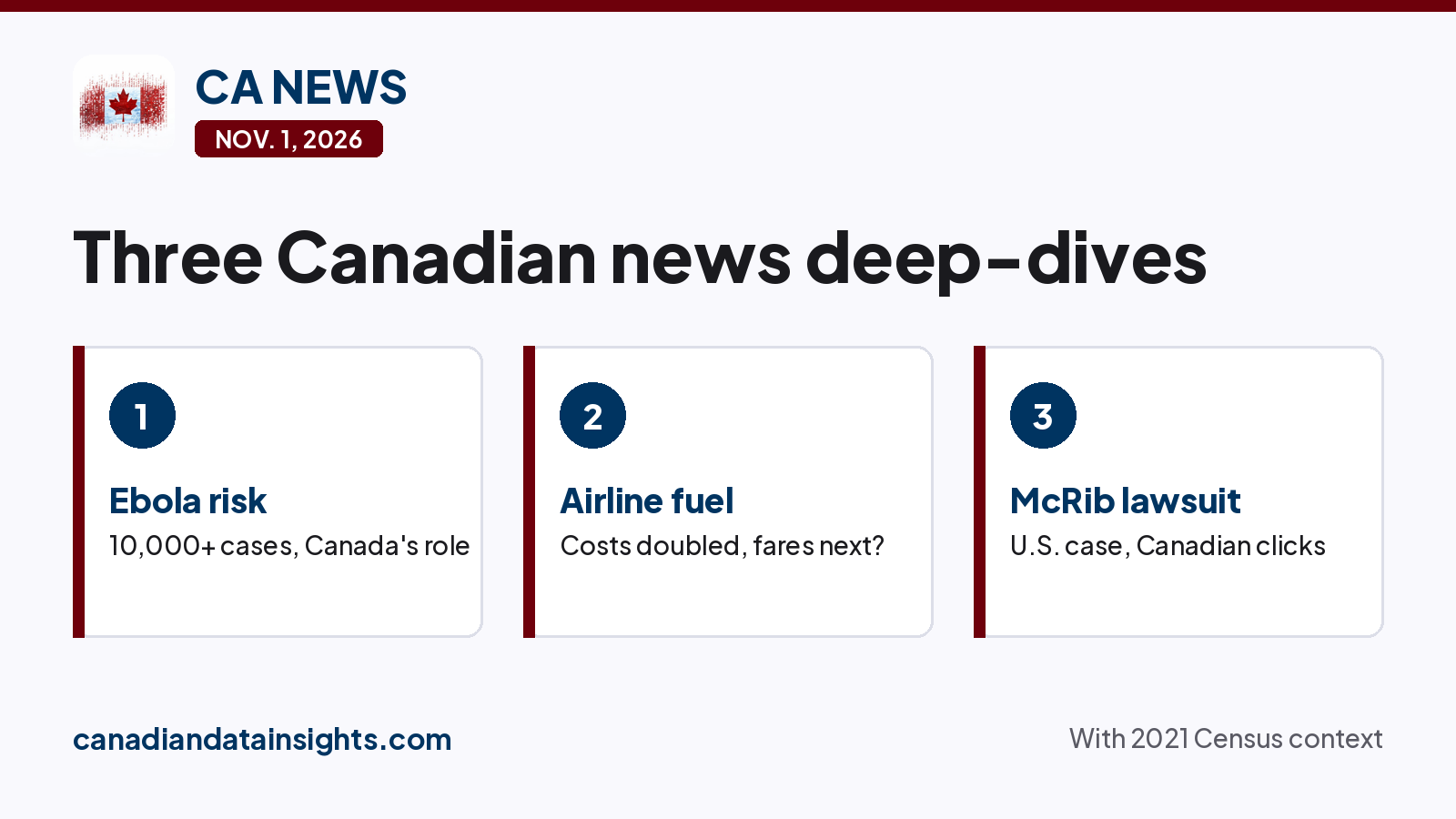
TL;DR: Today's most-searched Canadian news stories on Google Trends Canada, explained in depth. The Ebola outbreak in the Democratic Republic of Congo has passed 10,000 confirmed cases, and Africa's top doctor, who has called Canada home since 2013, is asking Canada for more support; the federal government says the risk here remains low, with border measures in place until Nov. 27. WestJet says jet fuel costs have doubled and airlines can pass only part of that on through fares, as Air Canada cuts its outlook. And Toronto police have issued a Canada-wide warrant for a suspect in the Bridle Path home invasion.
1. Ebola passes 10,000 cases: the Canadian angle, and Canada's actual risk
Confirmed Ebola cases in the Democratic Republic of Congo have surpassed 10,000, and the latest report from the country's public health institute shows the death toll has surpassed 5,000. The outbreak was declared in mid-May and is caused by the Bundibugyo strain, for which there is no approved treatment or vaccine. It is the country's largest-ever outbreak and the fastest-growing and second-largest Ebola outbreak ever recorded, behind only the 2014-2016 West Africa crisis, which infected more than 28,000 people (CBC News).
A Canadian voice at the centre: Dr. Jean Kaseya, director-general of the Africa Centres for Disease Control and Prevention, has called Canada home since 2013. His three children attend university in Toronto and his wife lives in Laval, Que. "No one is safe today," he told CBC News. "If this outbreak [continues] like that, with the same magnitude, in one year we'll have more than what West Africa had in two years and a half." He said the risk to Canada remains low, but urged Canada to "move from low to zero by supporting [Africa] to stop the outbreak where it is currently." His message to Canadians: "No fear, no panic, but take it seriously" (CBC News).
Where it has spread: smaller numbers of infections have appeared in Uganda, Kenya and Nigeria, which reported its first Ebola infection in a decade (CBC News).
What Canada has done: Canada committed $8 million to the response in May, including $2 million for Africa CDC. In late July, Health Canada authorized Moderna to launch a clinical trial of its Bundibugyo vaccine. University of Winnipeg microbiologist Jason Kindrachuk says Canadian and Congolese scientists have sequenced more than 1,000 genomes, but that "there's a real need for Canada and other countries to step up" (CBC News).
Canada's official risk and travel rules: the Public Health Agency of Canada says the overall risk to the general population in Canada remains low, and no importations of Ebola disease have previously occurred in Canada (PHAC). Temporary border measures apply to anyone who has visited or lives in Uganda, South Sudan or the DRC, even in transit, and last until Nov. 27, 2026 at 11:59 pm (PHAC). Asymptomatic travellers who were in those countries in the past 21 days must quarantine for 21 days, and foreign nationals who were in the DRC in that window can't enter (Canada Gazette).
By the numbers (2021 Census): Laval, where Kaseya's family lives, had 438,366 residents, next to Montreal at 1,762,949. Across Canada, health care and social assistance employed 12.7% of the labour force (2,446,370 of 19,310,340), the front line if a case ever were imported.
Why it matters to you: the risk in Canada is officially low. If you or family travel to or from Uganda, South Sudan or the DRC, check the border rules before Nov. 27.
Sources: CBC News · PHAC risk assessment · PHAC border measures · Canada Gazette
2. WestJet says jet fuel costs doubled. Will your airfare follow?
WestJet Group chief executive Alexis von Hoensbroech told the Calgary Chamber of Commerce on Oct. 29 that geopolitical tensions have caused jet fuel costs to double, while transborder demand slowed and the Cuban leisure market stayed closed. Fuel is an airline's single largest expense. "Canada's aviation system has very few shock absorbers left," he said, and WestJet called for a national strategy on cost pressures (Financial Post, CTV News).
The fare question: "Airlines can recover only part of the increase through fares, leaving thin margins to absorb the rest," WestJet said (Financial Post).
Air Canada's numbers: the same day, Air Canada reported record third-quarter operating revenues of $7 billion, but cut its full-year adjusted EBITDA guidance to $2.4 billion-$2.7 billion, from $2.9 billion-$3.2 billion. CFO John Di Bert cited a $906 million year-over-year increase in fuel expense, with fuel prices 10 cents per litre above expectations. It now expects to offset about 70 per cent of the extra fourth-quarter fuel cost, down from 100 per cent (Financial Post).
The loan fight: Air Transat and Porter were each approved for a $150 million four-year loan and Flair for $76 million under the federal LASR financing program. WestJet says those loans sway market dynamics: "We fundamentally believe that governments should not intervene in markets if they want a healthy and competitive industry" (Financial Post).
By the numbers (2021 Census): in Calgary, WestJet's home city, 6.4% of the labour force worked in transportation and warehousing (46,840 of 730,050), compared with 5.1% across Canada (981,030 of 19,310,340).
Why it matters to you: if airlines can pass on only part of a doubled fuel bill, watch for higher fares and fewer seats on thinner routes this winter. Booking flexibility is worth more than usual.
Sources: Financial Post · CTV News Calgary
3. Bridle Path home invasion: Canada-wide warrant for a suspect police say was shot by an accomplice
Around 3:40 a.m. on Thursday, Oct. 29, three suspects armed with firearms and a hammer forced their way into a home near Post Road and Hyde Park Circle, in Toronto's Bridle Path neighbourhood near Bayview and Lawrence avenues. They demanded valuables, a struggle broke out and multiple guns were fired. Three family members, aged 75, 26 and 28, were shot; the 75-year-old man and a 64-year-old woman were also struck with a hammer. All four were taken to hospital, and the suspects fled in a dark SUV before police arrived (Toronto Police Service).
The suspect: police have named Daijohn Richards, 23, of Toronto, and issued a Canada-wide warrant on charges including four counts of discharging a firearm with intent to wound, four counts of robbery with a firearm and three counts of aggravated assault. Investigators believe he was accidentally shot in the shoulder by an accomplice (Toronto Police Service, Global News).
The hospital gap: Richards walked into a Toronto hospital with a gunshot wound on Thursday. Police approached him there but did not yet have evidence to arrest him; he was discharged Friday afternoon, and police say they developed that evidence Friday evening, hours later. He is now missing (CBC News, The Globe and Mail).
Still at large: two other suspects, believed to be in their 20s and wearing dark clothes, have not been identified. "All three suspects are considered armed and dangerous and we are asking members of the public to not approach them," Insp. Kristy Smith said. Some family members have been released from hospital; police say injuries are life-altering, not life-threatening (CBC News, The Globe and Mail). Tips go to the Hold Up Squad at 416-808-7350.
By the numbers (2021 Census): single-detached houses are only 23.3% of occupied dwellings in Toronto (270,490 of 1,160,890), while apartments in buildings of five or more storeys are 46.7% (542,625). Across Canada, single-detached houses are 52.6% (7,872,310 of 14,978,940).
Why it matters to you: the case is rare and drew national attention because of where it happened. The open question is procedural: how a wounded suspect left hospital before police had grounds to hold him.
Sources: Toronto Police Service · CBC News · Global News · The Globe and Mail
Data sources
Population and labour-force figures are from the 2021 Census of Population as presented on Canadian Data Insights location pages; shares are calculated from those counts. See Data sources. News facts are from the linked reports. Topics were chosen using Google Trends Canada interest on the morning of Nov. 1, 2026. This post is for education only and is not medical, travel or legal advice.
Transportation and warehousing share of the labour force, 2021 Census (percent)
Source: Statistics Canada, 2021 Census of Population
Data source → Census methodology & attribution
Back to All Insights