Winnipeg vs Saskatoon: Population & Income Compared
Side-by-side 2021 figures for Winnipeg and Saskatoon: population, growth, median household income, and average age — with links to full profiles and the comparison tool.
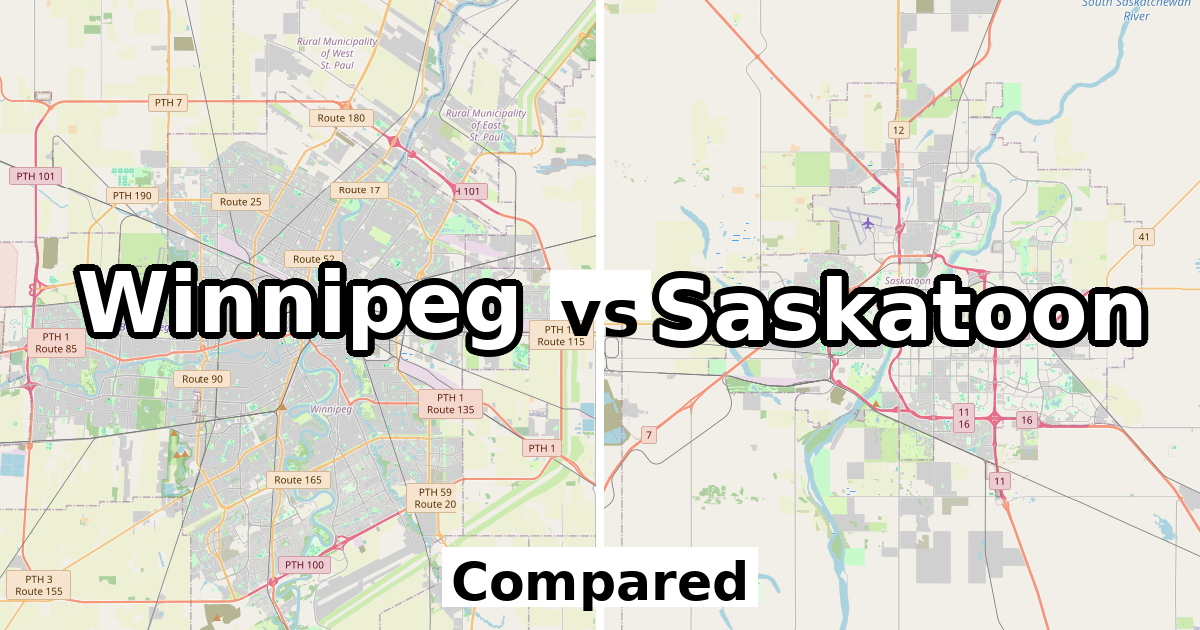
Winnipeg and Saskatoon are Prairie anchors — Manitoba's largest city and Saskatchewan's largest. Side-by-side 2021 figures highlight scale, growth, and income differences. Here is a clear head-to-head.
Population & growth
Winnipeg counted 749,607 residents in 2021, compared with Saskatoon at 266,141. Size, however, is not the same as momentum. Winnipeg's population rose 6.3% from 2016 to 2021, while Saskatoon grew 7.7% over the same period.
In short: Winnipeg remains more than twice as large; Saskatoon added people faster from 2016 to 2021.
Income
Median after-tax household income tells another part of the story. Saskatoon households sat at $74,500 (median after tax), versus $69,500 in Winnipeg. That gap matters for cost-of-living and labour-market conversations across the two cities.
Age profile
Average age was 40.3 years in Winnipeg and 38.8 in Saskatoon. Saskatoon's younger profile contrasts with Winnipeg in this census snapshot.
Quick comparison table
- Population (2021): Winnipeg 749,607 · Saskatoon 266,141
- Growth 2016–2021: Winnipeg 6.3% · Saskatoon 7.7%
- Median HH income (after tax): Winnipeg $69,500 · Saskatoon $74,500
- Average age: Winnipeg 40.3 · Saskatoon 38.8
Winnipeg is nearly three times Saskatoon's size; Saskatoon grew faster, has higher median household income, and a younger average age in 2021.
Explore the full datasets
Dig into every section (households, labour, languages, dwellings) on the location profiles, or build your own side-by-side:
- Winnipeg demographic profile
- Saskatoon demographic profile
- Location Comparison tool — select Census subdivision, then Winnipeg and Saskatoon
Winnipeg vs Saskatoon — Key Metrics
Source: Statistics Canada, 2021 Census of Population
Data source → Census methodology & attribution
Back to All Insights