Canadian News Deep-Dives — October 27, 2026: Chow Wins Again, Tedjo Takes Mississauga, the West Stops Falling Back
Three deep-dives: Olivia Chow wins a second term in Toronto with about 54% of the vote, Alvin Tedjo comes from fourth in the polls to beat Mississauga's current and former mayors, and Western Canada won't turn its clocks back on Nov. 1.
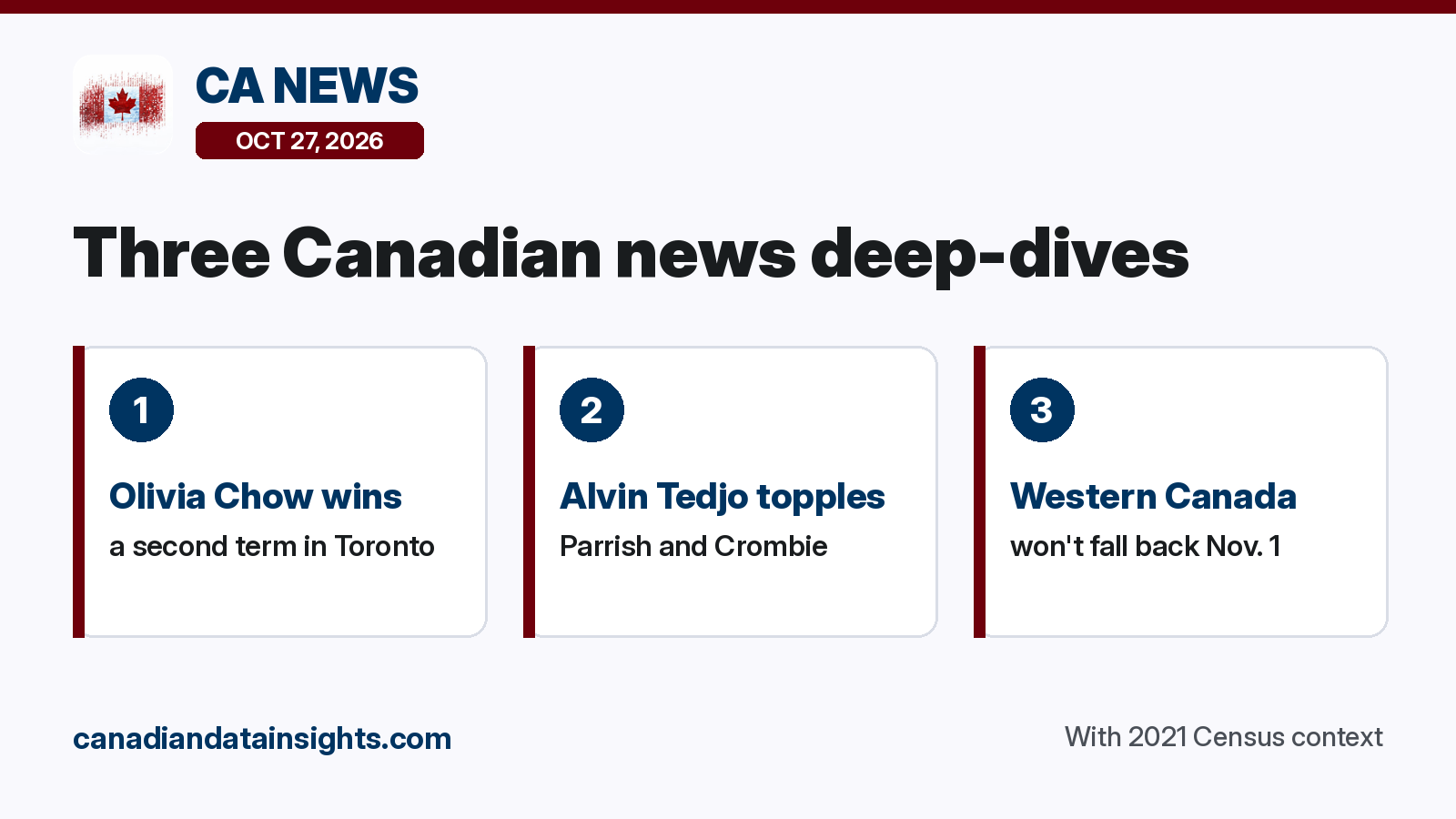
TL;DR: Today's three most-searched Canadian news stories on Google Trends Canada, explained in depth with 2021 Census context. Toronto re-elected Olivia Chow. Mississauga elected Alvin Tedjo over incumbent Carolyn Parrish and former mayor Bonnie Crombie. And on Sunday, Nov. 1, B.C., Alberta and Manitoba won't "fall back," splitting Canada into clock-changers and non-changers.
1. Olivia Chow wins a second term as Toronto mayor
Incumbent Olivia Chow won re-election as Toronto mayor on Monday, Oct. 26, defeating former councillor Brad Bradford, CBC News projected. Unofficial results with all 1,431 polls reporting gave Chow 532,201 votes (54.16%) and Bradford 404,013 (41.11%). The Globe and Mail reported the same split of about 54% to 41% with almost all votes counted.
Turnout: 982,660 ballots were counted, a turnout of 45.84% of 2,143,771 eligible voters (City of Toronto unofficial results). Advance voting jumped nearly 72% from the 2023 mayoral byelection: more than 222,000 early ballots from Oct. 6 to 11, up from over 129,000 in 2023 (City of Toronto, via CBC).
Where she won: CP24's ward-by-ward breakdown of unofficial results shows Chow won all five Scarborough wards with between 51% and 56.7% of the vote, and took 72.4% in Toronto Centre and 69% in Parkdale-High Park. Bradford won Etobicoke Centre (59%), York Centre (64.2%) and Eglinton-Lawrence (62.8%). Chow's narrowest lead was 0.7 points in Don Valley North, and she more than doubled Bradford's vote count in his own ward, Beaches-East York. Pollster Nick Nanos called it a "crushing victory" for her campaign team: "They delivered on the ground."
The close ones: CP24 also reported Chow ahead by just 0.9 points in Etobicoke North (45.4%), behind in Etobicoke-Lakeshore (47.1% to Bradford's 49.4%), and ahead in York South-Weston (48.8% to 43.9%), Humber River-Black Creek (49.7% to 40.7%) and Toronto-St. Paul's (by 5.1 points). Downtown she took 67% in Spadina-Fort York and 63.4% in University-Rosedale.
The polls said it was close: a Liaison Strategies poll the week before election day had Bradford at 49% and Chow at 47% among decided and leaning voters (margin of error ±3.1 points, 19 times out of 20), a statistical dead heat (CBC News). The final margin was about 13 points.
Record vote totals: both candidates received more votes than the winner of either of the last two mayoral races. John Tory won in 2022 with 342,158 votes, and Chow won the 2023 byelection with 269,372. In the 2022 municipal election, 563,124 ballots were cast in total (CP24).
A rematch: Chow and Bradford also faced each other in the 2023 byelection after John Tory resigned. When Chow first won in 2023, she became the first racialized person and the third woman to serve as Toronto mayor (CBC).
The new council: CBC projected progressive council wins including Diana Chan McNally (Parkdale-High Park), Chiara Padovani (York South-Weston, defeating long-time incumbent Frances Nunziata), Mike Layton (University-Rosedale), Nate Erskine-Smith (Beaches-East York) and Curran Stikuts (Toronto Centre).
In her victory speech, Chow said she had spoken with Prime Minister Mark Carney and Ontario Premier Doug Ford, pledged to keep investing in police, paramedics and community programs, and said she would keep Toronto's water "in public hands" (Globe and Mail).
By the numbers (2021 Census): Toronto had 2,794,356 residents (+2.3% since 2016), a density of 4,427.8 people per km², a median age of 39.6, a 2020 median household income of $84,000, a low-income rate of 13.2%, and 1,253,238 private dwellings (1,160,892 occupied).
How Toronto lives (2021 Census): about 46.7% of occupied dwellings (542,625 of 1,160,890) were apartments in buildings of five or more storeys, compared with about 23.3% single-detached houses (270,490) and 14.0% apartments in smaller buildings (162,245). Residents aged 65 and older made up 17.1% of the population and children 14 and under 13.8%. About 41.9% of residents (1,162,715 of 2,772,630) reported a mother tongue other than English or French. See Toronto on Canadian Data Insights.
Why it matters to you: Toronto's mayor and council set property taxes, housing approvals, TTC transit, policing and water policy for Canada's largest city.
Sources: CBC News · CBC News (council) · The Globe and Mail · CP24
2. Alvin Tedjo beats Parrish and Crombie to become Mississauga's mayor
Ward 2 councillor Alvin Tedjo has been elected mayor of Mississauga, defeating incumbent Carolyn Parrish and former mayor Bonnie Crombie. The City of Mississauga's unofficial results give Tedjo 74,479 votes, or 38.9% of ballots cast. CBC News reported Parrish at 51,853 votes (27.3%) and Crombie at 43,191 (22.7%); CBC put Tedjo's share at 39.2%. Unofficial turnout was 33.9%, with 191,166 voters casting ballots. Results remain unofficial until the City Clerk certifies them.
From fourth to first: a Liaison Strategies poll in August had Tedjo a distant fourth at 12% among decided and leaning voters, with Parrish and Crombie at 35% each. By Oct. 22 he had climbed to 31%, ahead of Parrish (28%) and just behind Crombie (35%), CBC reported. Tedjo had finished second to Parrish in the 2024 mayoral byelection, 25% to 31%.
A generational shift: Tedjo, 43, is just the fourth person to hold the job in nearly half a century. Hazel McCallion became mayor in 1978 and served 36 years, followed by Crombie for nearly a decade, then Parrish. Crombie had left the office to lead the Ontario Liberal Party and returned to municipal politics this year.
"It is beyond a doubt the honour of a lifetime to stand here as your next mayor of the city of Mississauga. This is a tremendous responsibility that I do not take lightly," Tedjo said. Conceding, Parrish said: "He's going to have a tough job ahead of him and he can pick up the phone and call me anytime, and I'll tell him what not to do."
By the numbers (2021 Census): Mississauga had 717,961 residents, down 0.5% from 721,599 in 2016, making it Canada's 7th-largest census subdivision. Its 2020 median household income was $102,000 (compared with $84,000 in Toronto), the median age was 40.8, the low-income rate was 9.4%, and about 45.9% of residents (328,130 of 714,840) reported a mother tongue other than English or French. The city had 254,089 private dwellings (244,575 occupied).
Why it matters to you: Mississauga's new mayor will help set property taxes, housing approvals and transit priorities for more than 700,000 people next door to Toronto.
Sources: City of Mississauga · CBC News · CTV News
3. Western Canada won't "fall back" on Nov. 1
When most of Ontario, Quebec, Atlantic Canada and Nunavut turn their clocks back an hour this Sunday, Nov. 1, much of Western Canada won't. Here's who is doing what:
- British Columbia: the final clock change was March 8, 2026. On Nov. 1 clocks stay put, completing the move to year-round Pacific time (PCT, UTC-7). The East Kootenay (including Cranbrook, Fernie, Sparwood, Invermere, Kimberley, Radium Hot Springs and Elkford) stays aligned with Alberta at UTC-6; Golden makes one last change on Nov. 1 to UTC-7.
- Alberta: the Official Time Act passed in June. From Nov. 1, clocks no longer reset to Mountain Standard Time; the province stays on "Alberta Time" (ABT) year-round.
- Manitoba: announced Sept. 17 that it will stay on daylight saving time permanently. Of nearly 72,000 survey votes, 92% wanted to end seasonal changes; 58% preferred permanent daylight time and 34% permanent standard time.
- Northwestern Ontario: Ontario said Oct. 13 it intends to make daylight time permanent in Kenora and communities west of the 90th meridian by Nov. 1 to stay aligned with Manitoba. The rest of Ontario keeps changing clocks.
- Already done: Yukon has been on permanent time since 2020 and Saskatchewan since 1966. The Northwest Territories is also ending time changes, and Quebec's Nunavik region has moved to permanent daylight time.
What about the rest of Ontario? Ontario's Time Amendment Act, 2020 would make daylight time permanent province-wide only once brought into force; CBC reports it depends on Quebec and New York doing the same.
The trade-offs: The Weather Network says Vancouver will see a 9:07 a.m. sunrise on New Year's Day and Edmonton a 9:50 a.m. sunrise. CBC reported Alberta's switch caused digital calendar problems for some; the global Time Zone Database was updated for Alberta in an Aug. 7 release, but some calendar and booking systems maintain their own.
By the numbers (2021 Census): the six provinces and territories with no clock change this fall — British Columbia (5,000,879), Alberta (4,262,635), Manitoba (1,342,153), Saskatchewan (1,132,505), the Northwest Territories (41,070) and Yukon (40,232) — had a combined 11,819,474 residents, about 32% of Canada's 36,991,981 (our sum; it excludes northwestern Ontario and Nunavik). Ontario (14,223,942) and Quebec (8,501,833) mostly keep changing their clocks.
Why it matters to you: from Nov. 1 the winter time gap between East and West changes — Vancouver will run two or three hours behind Toronto depending on the season — so double-check flights, meetings, broadcasts and calendar invites that cross provincial lines.
Sources: Government of B.C. · Government of Alberta · Government of Manitoba · Ontario Newsroom · CBC News (maps) · CBC News (Manitoba) · CBC News (Alberta calendars) · The Weather Network
Data sources
Population, income, age and dwelling figures are from the 2021 Census of Population (income for 2020) as presented on Canadian Data Insights location pages. See Data sources. Election results are unofficial until certified. News facts are from the linked reports. Topics were chosen using Google Trends Canada. This post is by Andrew and is for education only; verify primary sources.
No clock change this fall — population of provinces/territories on permanent time (2021 Census, thousands)
Source: Statistics Canada, 2021 Census of Population
Data source → Census methodology & attribution
Back to All Insights