
Canadian News Deep-Dives — October 30, 2026: Ottawa's $1.6B Cohere Stake, 735 CRA Job Notices, Who Falls Back Nov. 1
Three deep-dives: why Ottawa is buying up to $1.6 billion of Toronto AI company Cohere and what it gets in return, what 735 workforce adjustment notices mean at the Canada Revenue Agency, and which Canadians will and won't turn their clocks back on Sunday.
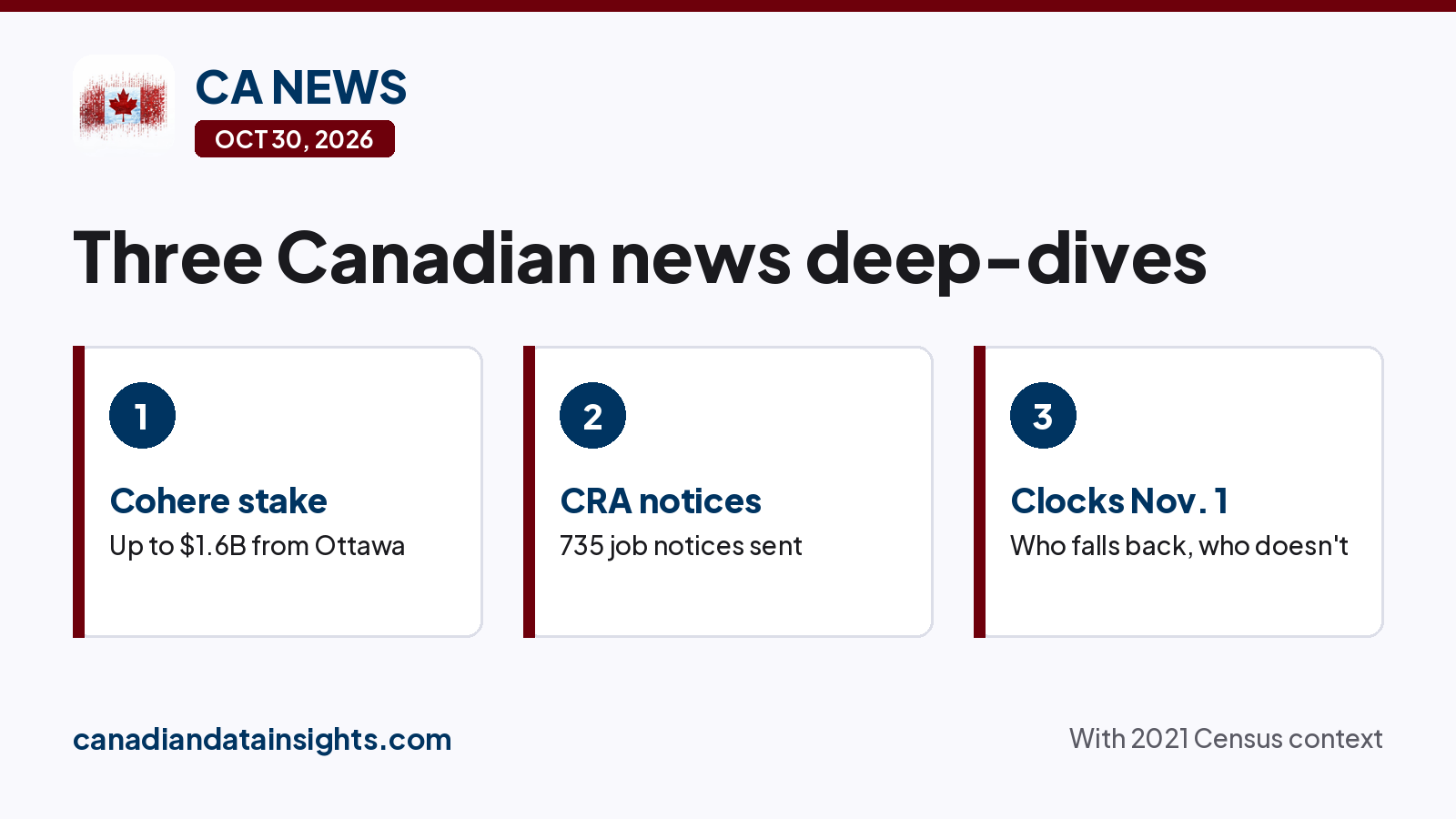
TL;DR: Today's three most-searched Canadian news stories on Google Trends Canada, explained in depth with 2021 Census context. Ottawa will invest up to $1.6 billion for a stake in Toronto-based AI company Cohere, tied to 1,000 jobs and $1.7 billion in Canadian computing by 2030. The Canada Revenue Agency sent 735 workforce adjustment notices, with up to 260 employees expected to leave. And on Sunday, Nov. 1, most of Ontario, Quebec and Atlantic Canada fall back an hour while B.C., Alberta and Manitoba don't.
1. Ottawa will invest up to $1.6 billion in Cohere. Here's what it gets in return
On Thursday, Oct. 29, Prime Minister Mark Carney announced the federal government's commitment to make an equity investment of up to $1.6 billion in Cohere, the Toronto-founded company that builds secure AI systems for businesses and governments. The government calls it a commercial investment, made alongside private investors including NVIDIA, Bell and Germany's Schwarz Group, and paid out in stages (Prime Minister of Canada).
The strings attached: Cohere will create at least 1,000 new high-paying Canadian technical jobs by 2030, commit at least $1.7 billion to additional computing infrastructure in Canada by 2030, and keep its Canadian incorporation and headquarters. Ottawa says it will get regular reporting on progress against those commitments. "Cohere will stay Canadian, creating more opportunities for our workers and businesses. Its incorporation and headquarters will remain here," Carney said (CBC News).
The bigger round: the federal money is part of a planned $7-billion financing that would value Cohere at $35.7 billion, which The Globe and Mail says is the largest-ever financing by a Canadian startup. Schwarz Group, owner of Lidl and Kaufland, led the round after pledging $780 million in April as part of Cohere's merger with German AI developer Aleph Alpha. Cohere has completed only an initial close and did not say how much has been committed so far (CBC News).
Not the first cheque: in 2024, a federal industrial fund awarded Cohere $240 million to help pay for computing power to train its models on Canadian soil. AI Minister Evan Solomon said the new investment was made on "very favourable commercial terms" and will be paid out as Cohere reaches its hiring and infrastructure commitments (The Globe and Mail).
By the numbers (2021 Census): in Toronto, where Cohere was founded, 10.5% of the labour force (159,770 of 1,518,420) worked in natural and applied sciences occupations, compared with 8.2% for Canada. That is the talent pool the 1,000-job pledge draws on.
Why it matters to you: Canadians, through the federal government, will own part of a private AI company. Whether that pays off depends on Cohere hitting its 2030 targets, which the government says it will track. This is general information, not investment advice.
Sources: Prime Minister of Canada · CBC News · The Globe and Mail
2. The CRA sends 735 workforce adjustment notices: who is affected
On Wednesday, Oct. 28, the Canada Revenue Agency told 735 executive and non-executive employees at its Ottawa headquarters and regional offices that their positions may be affected by workforce adjustments. The CRA gave guarantees of continued employment to 110 of them, mainly in compliance, and says up to 260 employees are expected to leave (CTV News Ottawa; Ottawa Citizen).
Which branches: the Union of Taxation Employees said 534 of its members got notices, in the Appeals Branch; Assessment, Benefit, and Service Branch; Commissioner's Office; Human Resources Branch; and Compliance Programs Branch. Reasons cited include the end of pandemic-related funding and workloads, expenditure reductions, organizational streamlining, centralization, and digital or self-service delivery. A CRA spokesperson confirmed no letters went to contact centre workers, who field taxpayers' calls (Ottawa Citizen).
A notice is not a layoff, yet: affected employees may receive a guarantee of a reasonable job offer, a voluntary departure option, or go through a layoff determination process (UTE; PSAC).
The bigger picture: the CRA employed 48,774 people as of March 31, 2026, down from 52,499 a year earlier. Its 2026-27 departmental plan shows $1.2 billion in spending reductions over three years, and in April it said up to 210 jobs were being cut, mainly linked to winding down the federal fuel charge. Budget 2025 set out a plan to shrink the federal public service by 28,000 positions by 2029. The Public Service Alliance of Canada has announced a strike vote for roughly 120,000 federal public servants (CTV News).
By the numbers (2021 Census): in Ottawa, 21.1% of the labour force (116,235 of 549,985) worked in public administration, more than three times the national share of 6.2% (Canada). Federal cuts land hardest on the capital's economy.
Why it matters to you: the CRA says services to Canadians will continue without disruption and contact centres were spared this round. If you are a federal employee who got a notice, read it closely and note its deadlines.
Sources: CTV News Ottawa · Ottawa Citizen · Union of Taxation Employees · PSAC
3. Clocks fall back Sunday, but not everywhere: who's ending the time change
On Sunday, Nov. 1, most of Ontario, Quebec and the Atlantic provinces will turn their clocks back an hour for the end of daylight saving time. Most of British Columbia, as well as Alberta, Manitoba and the Northwest Territories, are no longer changing their clocks, joining Yukon and Saskatchewan (CBC News).
Province by province: B.C.'s last change was March 8, 2026; its year-round time is now called Pacific time (PCT), UTC-7 (Government of British Columbia). Alberta has adopted permanent Alberta Time (ABT), previously Mountain Daylight Time (Government of Alberta). Manitoba Premier Wab Kinew announced the change in September after more than 90% of 72,000 online votes said time was up for the switch (Winnipeg Free Press). And Quebec Premier Paul St-Pierre Plamondon said Wednesday his government is moving to end the clock change, without yet deciding which time to keep (CBC News).
The health debate: sleep researchers say permanent standard time, the time we return to in the fall, fits the body's internal clock better than permanent daylight time, which several provinces chose. University of Calgary professor Michael Antle said standard time would have been better for Alberta, given its already-late winter sunrises: "It's not the choice I would have made" (CBC News).
By the numbers (2021 Census): the six provinces and territories that won't fall back had 11,819,474 residents, about 32% of Canada's 36,991,981 (B.C. 5,000,879; Alberta 4,262,635; Manitoba 1,342,153; Saskatchewan 1,132,505; N.W.T. 41,070; Yukon 40,232). Ontario, Quebec and the four Atlantic provinces, which still change, had 25,135,649 (about 68%). These are whole-province totals; local exceptions, such as northwestern Ontario and parts of B.C., are not adjusted.
Why it matters to you: from Sunday, the time gap between Toronto and Calgary or Vancouver changes for the winter. Double-check cross-province meetings, flights and appointments, and update older devices that may not adjust automatically.
Sources: CBC News · Winnipeg Free Press · Government of British Columbia · Government of Alberta
Data sources
Population, occupation and industry figures are from the 2021 Census of Population as presented on Canadian Data Insights location pages; shares are calculated from those counts. See Data sources. News facts are from the linked reports. Topics were chosen using Google Trends Canada interest on the morning of Oct. 30, 2026.
Population by Nov. 1 clock change, 2021 Census (millions; whole-province totals)
Source: Statistics Canada, 2021 Census of Population
Data source → Census methodology & attribution
Back to All Insights